
This Research Method Rewired How I Create Content That Converts - and Noone Else Does It!
Turn scattered audience insights into sharp, high-performing content, without adding another call or spreadsheet to your week.

Hi I’m Melanie, a LinkedIn consultant & strategist who turns insider knowledge and sharp strategy into measurable results for ambitious professionals.
Most people treat LinkedIn like a guessing game, endlessly mimicking familiar formats, recycling vague advice, and hoping their audience eventually notices.
They scroll, copy, and post, but despite all the activity, their content continues to feel like it’s missing the mark - too safe, too generic and, quite frankly, too forgettable.
While we’re all busy trying to sound more knowledgeable than the next person, many are missing the one thing that truly makes content resonate: emotional accuracy.
And the best place to find that? Surprisingly, it’s not LinkedIn at all!
It’s Reddit.
Now, don't freak out that I’ve mentioned another platform.
I only use it for one thing - and that’s to get a competitive edge, so it’s worth hopping over there (I haven’t even created an account) - agreed?
Reddit, for all its chaos and anonymity, is where people speak with a kind of candour you’ll never find on LinkedIn. It’s where the masks come off, where people vent their frustrations, confess their doubts, and describe their challenges in brutally honest detail, without trying to impress anyone.
It’s an untapped strategic asset - one that can give you a significant edge over competitors still relying on surface-level assumptions.
The Contradiction That Changed Everything
I don’t even have a Reddit accoun but Reddit has helped me create lead magnets that convert, write posts that get dozens of DMs, and develop positioning so sharp it makes competitors look like they’re guessing.
Not by posting.
Not by engaging.
Just by listening.
While your competition is copy-pasting the same “How to grow on LinkedIn” content, you’ll be building products and writing posts that hit a nerve because they’re based on unfiltered human truth.
Here’s what everyone misses…
Your ideal client may not be on Reddit.
But their employees, candidates, and frustrated peers are.
They’re confessing what no one says in boardrooms.
They’re ranting about the tools they hate, the tasks that exhaust them, the pressure they can’t admit to feeling.
And if you listen? You’ll understand exactly what your buyer is quietly dealing with, without them ever telling you.
Here’s why:
1. Access to Raw, Unfiltered Insight
Reddit isn’t curated. That’s precisely its power. It reveals how your audience speaks when they’re not selling, posturing, or performing. This is where people tell the truth about what they’re struggling with, what they wish existed, and how they really feel. And that’s where your positioning becomes sharper than anyone else’s.
2. Faster Pattern Recognition
Because Reddit discussions are long-form and emotionally charged, they expose the underlying frustrations your audience repeatedly faces. Instead of guessing at surface-level pain points, you’ll see the root causes emerge again and again, which allows you to create content, products, and offers that directly address what matters most.
3. A Competitive Edge Few Are Using
Most of your competitors won’t go near Reddit. Either they underestimate its value or dismiss it entirely as irrelevant. That creates an opportunity for you to speak more precisely, more convincingly, and more empathetically because your inputs are grounded in truth, not trends.
4. Perfect for Translating Into LinkedIn and Substack
This isn’t about creating content on Reddit. It’s about listening deeply and then using what you find to fuel content elsewhere. Your LinkedIn posts become more targeted. Your Substack essays hit a nerve. Your lead magnets become must-downloads, not maybes.
Anticipated Concern: “But my audience isn’t on Reddit.”
That may be true - at least directly. If you’re targeting senior executives or risk-averse professionals, they may not be posting but their employees, candidates, and junior team members are.
What they say reveals the internal friction your buyer is quietly navigating. You can use that insight to create content that speaks to the internal tension, the unspoken challenges, and the bigger-picture narratives decision-makers care about.
So no, Reddit doesn’t replace LinkedIn or Substack but it gives you something they can’t: unfiltered human truth. And when you integrate that into your messaging, you don’t just publish - you connect.
That’s what makes this method so powerful. And if you embrace it, it won’t just change how you write. It’ll change how your audience hears you.
Let’s explore how the method works in practice.
The Reddit Research Method: A 3-Step Approach
Step 1: Find the Friction
Go to r/freelance, r/humanresources, r/startups. Search for struggle-based keywords: “burned out by,” “can’t figure out,” “why won’t this work?”
Look for threads with 50+ comments.
Step 2: Read Every Damn Comment
Log phrases, not summaries. What’s the first complaint? What’s the emotion behind it? Create a spreadsheet. Spot the repeat pain.Step 3: Build from the Bottleneck
If 7 people say, “I can’t show my CFO what LinkedIn actually does for us,”
You build a damn LinkedIn ROI dashboard.
And guess what? It’ll convert — because it solves a validated, emotional, repeating pain.Let’s walk through the method that sharpens your messaging and reshapes your LinkedIn strategy.
Step 1: Find the Right Threads
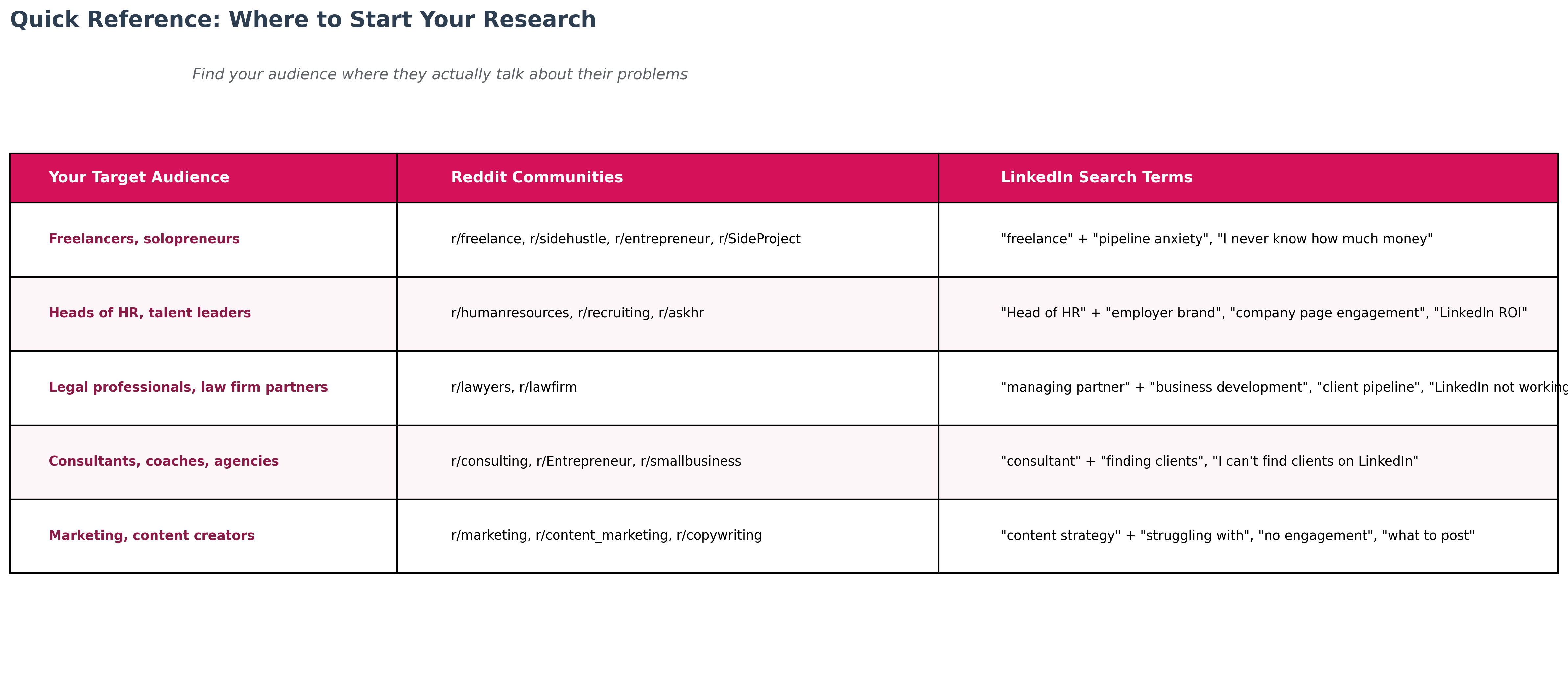
Start by heading to subreddits where your target audience or their ecosystem actively spends time. Think of communities like r/freelance, r/entrepreneur, r/consulting, or r/humanresources. Use search terms that indicate struggle or confusion - phrases like “struggling with,” “can’t figure out,” “overwhelmed by,” or “need help with.”
Sort the results by ‘Top’ and filter for posts from the past year. Prioritise discussions that have at least 50 comments - you’re not looking for quick takes, but for meaningful threads where people are genuinely unpacking their challenges.
The goal isn’t to find the loudest post, but the most revealing conversations. Bookmark around ten threads to begin with. That gives you a strong enough sample to start spotting patterns - not outliers, but recurring bottlenecks that signal real, unsolved problems.
Step 2: Read Every Comment (Yes, Every One)
This is where the honey pot is sitting 🍯 Open each thread and start reading the comments in full. Don’t skim. Don’t rush. You’re not looking for quick answers-you’re looking for recurring language and patterns.
Pay close attention to the first problem mentioned in each comment. Then look deeper. Often, the real insight emerges not in the first reply, but two or three responses into the thread - after the initial venting has passed and the commenter explains what’s really bothering them.
Create a spreadsheet with the following columns: - Problem Theme - Exact Phrase Used - Frequency - Thread URL
As you populate it, you’ll begin to notice patterns: the same problem described in slightly different ways, or one phrase that appears again and again. That’s your signal.
The problem that recurs most frequently and with the most emotional weight is your “early narrow” problem. It’s the one that deserves to shape your next piece of content, your next lead magnet, or your next offer.
Step 3: Translate Insight Into Actionable Content
Once your spreadsheet has enough entries - ten rows is plenty to start - you’ll have a clearer picture of what your audience actually cares about.
Not what they say when they’re trying to sound professional, but what keeps them up at night.
Now translate that into LinkedIn assets: - Use their exact phrasing in your headline, your profile About section or your opening sentence.
- Craft a story-based post around the emotional journey they described.
- Build a checklist, dashboard, or template that helps solve the recurring issue.
If your spreadsheet tells you that founders keep saying, “I never know how much money I’m making next month,” your next offer should be something like a pipeline tracker or income forecast template.
If HR leaders are repeatedly mentioning, “I can’t show my CFO what LinkedIn actually does for us,” then your next lead magnet might be a simple ROI dashboard designed specifically for internal reporting.
The pro move: Don’t just pick one source. Combine Reddit (for unfiltered employee and mid-level voice) with LinkedIn comments (for how decision-makers frame problems publicly).
When does the same pain point appear in both places? That’s your signal it’s real and worth building around.
Real Example: From Reddit Thread to LinkedIn Lead Magnet
Let me show you how this works in practice – because theory is one thing, but real results are what matter.
A client of mine serves Heads of HR.
They were stuck: excellent employer branding, but no way to prove ROI.
So we did one thing: Reddit research.
12 threads. 80+ comments. One phrase appeared 7 times:
“I can’t show my CFO what LinkedIn actually does for us.”
That became our lead magnet:
📊 A Talent ROI Dashboard.
📘 A 5-page guide on how to present it to leadership.
🔥 It converted. Fast.
No guesswork. Just research → resonance → results.
Sound familiar?
We knew we needed to understand the exact language they use when they’re under pressure – not the polished version they’d share in a board meeting, but the raw frustration they confess to peers.
So we did the research.
We started with r/humanresources and r/recruiting (to get the unfiltered employee and TA perspective), LinkedIn comment threads under employer branding posts, and Quora questions like “How do I measure LinkedIn ROI for recruiting?”
Across 12 threads and 80+ comments, one phrase appeared seven times with unmistakable emotional weight:
“I can’t show my CFO what LinkedIn actually does for us.”
Related variants kept surfacing too:
“Our page is a black hole – we post and nothing happens.”
“I have no benchmark for whether we’re doing LinkedIn ‘right’.”
“The analytics feel too high-level to drive decisions.”
This wasn’t noise. This was a bottleneck. And it was universal.
Here’s what we built:
A LinkedIn Talent ROI Dashboard – nothing fancy, just a practical Google Sheets template with pre-mapped metrics (reach to target talent roles, careers content clicks, applications influenced, time-to-hire) plus three simple, board-ready talking points my client could use when the CFO asked the inevitable question.
We paired it with a mini-guide: five pages that explained which metrics matter to HR, how to log them weekly, and exactly how to present them to leadership.
This converted.
The entire positioning came from one focused research sprint. Ninety minutes. That’s it.
Because we didn’t guess at what mattered. We listened to what people were actually struggling with, captured their language, and built something that solved their exact problem.
That’s the power of this method.
Warning: 3 Mistakes to Avoid
I’ve run this method with dozens of clients, and I’ve seen where people get stuck. Let me save you the time.
Overfitting One Viral Thread
You need patterns, not outliers. Ten threads, not one rage-post.Copying Reddit Tone for Execs
Translate the emotion. Don’t lift the profanity. Social media is raw. They’re brutally direct in ways most professionals would never be in public.If you’re targeting CFOs, managing partners, or risk-averse executives, you can’t lift phrases verbatim from Reddit. You’ll sound like you don’t understand your audience!
Reddit phrasing: “I have no f***ing clue if LinkedIn is doing anything for us. We throw content at it and nothing sticks.”
Professional translation: “I can’t show my CFO what LinkedIn actually does for us.”
Same problem. Different language. Now it lands.
Solving Every Problem You Find
Stick to problems that overlap with what you solve. Don’t pivot because Reddit told you to.
Don’t build your entire positioning around one highly upvoted rant. It’s an outlier dressed up as a pattern.
Implement This System in 90 Minutes
Monday (30 min): Find 10 threads
Wednesday (45 min): Log exact pain phrases
Friday (15 min): Turn one into a LinkedIn hook + lead magnet idea
Use this method on any platform
Here’s the thing: Reddit is powerful. But it’s not where everyone hangs out.
If you’re targeting senior executives, risk-averse professionals, or established decision-makers, they might not be on Reddit at all. And that’s fine – because the logic of this method works on any platform where people discuss problems candidly.
You just need to adapt where you look and how you interpret what you find.
LinkedIn Comments (Best for Decision-Makers)
This is where I’d start if your ICP includes CHROs, partners, executives, or senior leaders.
Search LinkedIn posts by job title + pain-point keywords. For example:
“Head of HR” + “employer brand”
“Managing Partner” + “business development”
“Finance Director” + “recruiting ROI”
Filter by posts with 20+ comments. You want conversations, not one-liners.
Then apply the same method: read every comment, note exact phrases, and look for the problem that emerges 3–4 replies deep. On LinkedIn, just like Reddit, the real insight surfaces after the initial venting passes and people explain what’s actually bothering them.
Sales Call Transcripts & Intake Forms (Your Own Data)
If you run discovery calls, strategy sessions, or client onboarding, you have a goldmine sitting in your email or note-taking app.
Transcribe 5–10 recent calls ( use Read.ai to download my transcripts after calls). Apply the same 3-step method: find recurring language, note exact phrases, and identify bottlenecks.
Why is this so powerful? You’re capturing executive language directly. High-value objections. Real concerns. The unvarnished version of your buyer’s problem.
This is arguably more valuable than any platform, because it’s your actual market talking to you, not strangers on the internet.
Customer Reviews (G2, Capterra, Trustpilot, Amazon)
For SaaS, tools, templates, or service businesses, reviews are treasure troves.
Look for the negative and neutral reviews (not the five-star raves). That’s where you’ll find post-purchase frustration and unmet expectations.
People write detailed reviews when something has disappointed them. They explain what they thought they were buying vs. what they actually got. That gap is your insight.
Layered Approach (Recommended for Senior / Conservative Audiences)
Here’s the real power move: don’t pick just one platform. Blend them.
For a Head of HR or managing partner, I’d research across:
Reddit (employee voice, unfiltered frustration, what they won’t say in meetings)
LinkedIn comments (how decision-makers publicly frame problems, what they’re willing to discuss with peers)
Your own sales calls (high-value objections, executive priorities)
Cross-reference all three. When you find a pain point that shows up in the employee vent and the executive comment and your sales calls? That’s a universal bottleneck. That’s the problem worth building your positioning around.
Your Next Step: The 90-Minute Research Sprint
You’ve read the method. You understand why it works. But reading and doing are two different things.
Here’s what I want you to do this week:
Monday (30 minutes): Find Your Threads
Pick one ICP. One. (Maybe it’s Heads of HR. Maybe it’s legal partners. Maybe it’s consultants trying to find clients. Pick your person.)
Go to Reddit or LinkedIn (or both).
Search for 10 threads or comment discussions where that person is discussing problems related to what you do.
Bookmark them. Save the URLs.
Thirty minutes.
Wednesday (45 minutes): Build Your Spreadsheet
Open a fresh Google Sheet or Notion doc.
Create four columns: Problem Theme | Exact Phrase | Frequency | Thread URL
Read every comment in those 10 threads.
Paste in exact phrases people use. Tally frequency. Identify patterns.
Sort by frequency and emotional intensity.
When you’re finished, you’ll have your answer: What’s the one problem your audience mentions most, with the most energy? That’s your “Early Narrow” problem.
Forty-five minutes.
Friday (15 minutes): Sketch Your Next Move
Take your top problem.
Draft one LinkedIn post hook using their exact language.
Sketch out one simple lead magnet that solves that problem (a template, a checklist, a dashboard, a mini-guide – nothing complicated).
Fifteen minutes. You’ll have the skeleton of your next offer.
Total time: 90 minutes. Total impact: Game-changing clarity.
And if you want help?
If you’re thinking, “I like this, but I need someone to walk me through it and help me translate my findings into a real LinkedIn strategy.”, that’s what I do.
Let’s Make Your Messaging Unmissable
If you’re thinking, “I like this, but I need someone to walk me through it and help me translate my findings into a real LinkedIn strategy,” that’s exactly what my training sessions are designed for.
I run 90-minute 1:1 LinkedIn training sessions where we:
Refine your positioning and search engine optimise your profile
Map your next 3 content pillars + 1 lead magnet
Understand the LinkedIn algorithm so your posts go further
Build a strategy rooted in truth, not guesswork
Advice on the most highly converting types of posts and how to structure them for maximum effect
Here’s the bottom line:
Your audience is already telling you exactly what they need – their exact language, their real pain points, their deepest frustrations.
You just need to know where to listen.
Let’s make your voice on LinkedIn actually mean something.
Agree Reddit is a great place to find meaningful content ideas! Also, this can be done on a larger scale via Reddit’s data API, which is free if you’re not using it to build a commercial app.
The 3-step Reddit method is really cool. I have used Reddit to find so many cool ideas for writing blog posts or even just finding the right angles on a subject I am writing about. Though I feel its utility keeps waning. Thanks for sharing, Melanie!