There is a quiet panic running through my inbox this month.
It comes from lawyers with 15,000 LinkedIn followers who have realised, uncomfortably, that they do not own a single one of them. It comes from financial advisers who spent three years building a personal brand on a platform that can throttle their reach tomorrow without explanation. It comes from consultants who watched a competitor lose an account overnight because a compliance officer decided LinkedIn was “too public”.
The panic is not really about LinkedIn.
It is about the dawning realisation that a following is not an audience and a platform is not a business.
For the last decade, the advice for professionals was straightforward: build on LinkedIn. Post consistently. Grow your network. That advice was correct. It is now incomplete.
In 2026, the operators who are quietly compounding - the ones getting inbound work while their peers get impressions - are running a two-platform system. LinkedIn does one job. Substack does another. Notes stitches them together.
This is the flywheel. And once you see it, you cannot unsee it.
By the end of this essay you will have a scorecard to check your own setup, a four-essay sequence to launch your Substack, a Notes routine you can start tomorrow, and two sentences to take to your compliance team on Monday.
The problem with one-platform strategies
Let me put a number on the risk.
Substack’s own data team, after studying thousands of publications, recommends one long-form post per week as the growth benchmark. Their reasoning is simple: growth is tied to output, and one deep piece a week is the minimum viable rhythm for compounding.
LinkedIn’s advice, in practice, is almost the opposite. Post daily. Comment daily. Feed the algorithm. Miss a week and your reach collapses.
Both platforms are telling the truth about themselves. But they are telling you two different truths, and if you only listen to one, you end up with one of two failure modes:
The LinkedIn-only creator has reach but no ownership. Every post is rented. Every follower is a lead they cannot email. Every algorithm change is an existential event.
The Substack-only creator has ownership but no discovery. The essays are beautiful. The list grows by five subscribers a week. The compounding never starts because nobody new ever arrives.
Neither of these is a business. They are hobbies with different risk profiles.
What the flywheel actually is
The flywheel is not a content calendar. It is a division of labour between two platforms that were, quietly, built to work together.
LinkedIn is your discovery engine. It is where new people find you. Its job is reach, not depth. You post to be seen by strangers.
Substack is your owned audience. It is where interested people go deeper. Its job is depth and ownership, not reach. You publish to be read by people who already trust you enough to give you their email address.
Notes is the connective tissue. Substack Notes now operates on the same discovery mechanics that made early LinkedIn work — engagement-based distribution, in a feed of people already primed to subscribe rather than scroll.
Here is what the loop looks like in practice:
A stranger sees your LinkedIn post → engages → visits your profile
Your profile links to your Substack → they subscribe (free)
They read your Sunday long-form → trust deepens
They see your Notes → they restack, share, and pull in their network
Their network subscribes to your Substack → the loop restarts, now inside Substack’s ecosystem
A percentage of subscribers convert to paid, to your service, or to your product
Every rotation of the wheel deposits owned subscribers into an asset you control.
This is what Lenny Rachitsky built to over one million subscribers, publishing once a week. It is what Nicolas Cole built publishing twice a week. And in a niche much closer to yours, it is what Kristina God — my co-host for the August bootcamp - used to reach 22,000+ subscribers and Substack’s Top 15 International Bestseller list.
None of them are on LinkedIn all day. All of them own their audience.
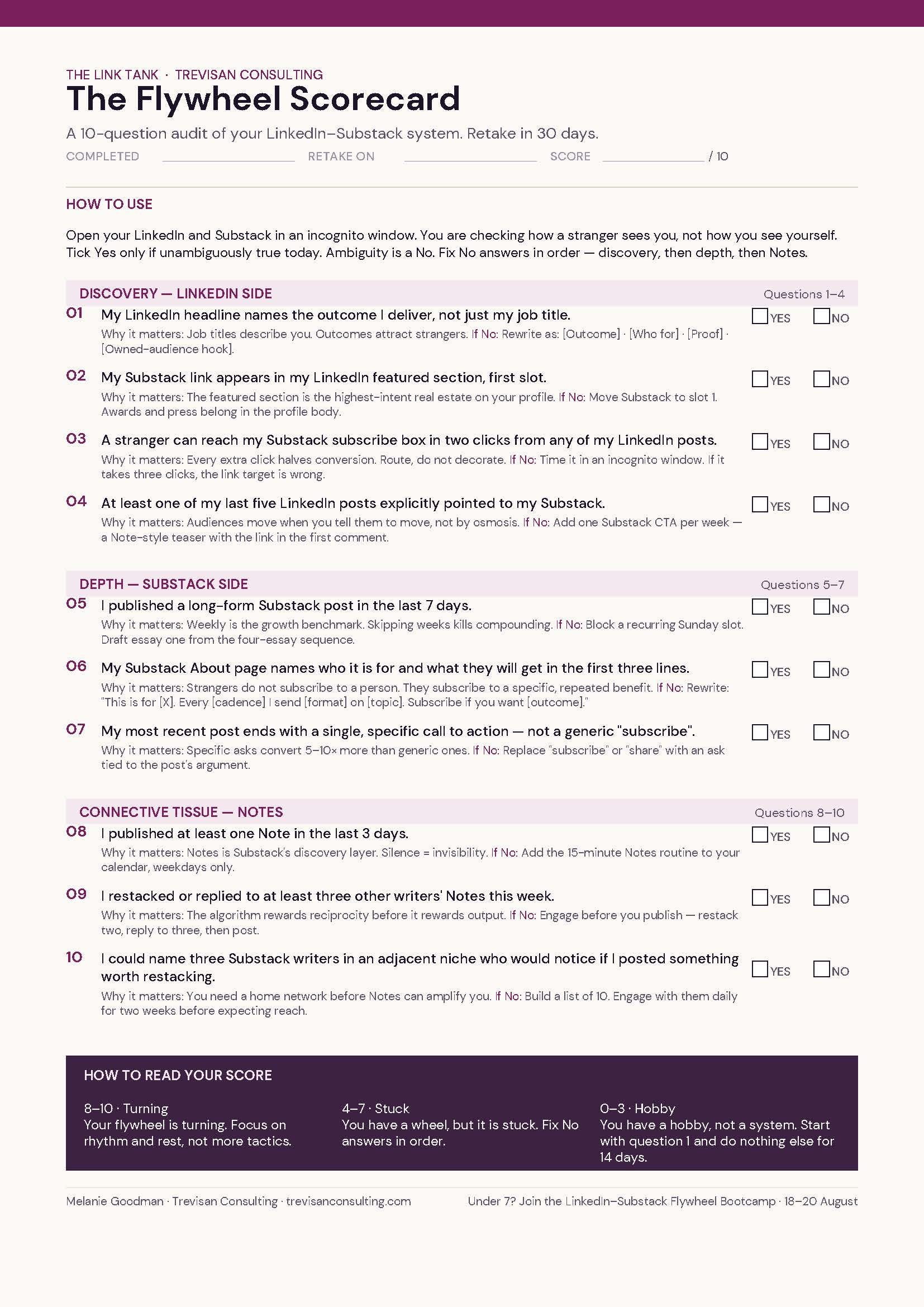
The Flywheel Scorecard
Before you change anything, find out where you actually stand.
How to complete it
Set aside 10 minutes. Open your LinkedIn profile and your Substack in an incognito or private browser window - this is the single most important instruction on the page. You are checking how a stranger sees you, not how you see yourself.
Go through each statement in order. Tick Yes only if the answer is unambiguously true today, not “mostly”, not “I’ve been meaning to”, not “next week”. Tick No for everything else. Ambiguity is a No.
When you are done:
Total your Yes answers and read the scoring rubric below.
Date the scorecard — today’s date, and a retake date 30 days from now. The value of this exercise is the delta between the two.
Fix your No answers in order — discovery first (1–4), then depth (5–7), then Notes (8–10). Do not skip ahead. A broken doorway makes every downstream move less effective.
My LinkedIn headline names the outcome I deliver, not just my job title. ☐ Yes ☐ No
My Substack link appears in my LinkedIn featured section, first slot. ☐ Yes ☐ No
A stranger can get from any of my LinkedIn posts to my Substack subscribe box in two clicks. ☐ Yes ☐ No
At least one of my last five LinkedIn posts explicitly pointed to my Substack. ☐ Yes ☐ No
Depth (Substack side)
I published a long-form Substack post in the last 7 days. ☐ Yes ☐ No
My Substack About page names who it is for and what they will get, in the first three lines. ☐ Yes ☐ No
My most recent post ends with a single, specific call to action, not a generic “subscribe”. ☐ Yes ☐ No
Connective tissue (Notes)
I published at least one Note in the last 3 days. ☐ Yes ☐ No
I restacked or replied to at least three other writers’ Notes this week. ☐ Yes ☐ No
I could name three Substack writers in an adjacent niche who would notice if I posted something worth restacking. ☐ Yes ☐ No
How to read your score
8 or more: Your flywheel is turning. Focus on rhythm and rest, not more tactics.
4 to 7: You have a wheel, but it is stuck. Fix the No answers in order — discovery, depth, then Notes.
0 to 3: You have a hobby, not a system. Start with move one below and do nothing else for two weeks.
Screenshot this. Send it to a colleague. Come back to it in 30 days.
Move one: turn LinkedIn into a doorway, not a destination
Most LinkedIn profiles are designed to impress. Flywheel profiles are designed to route. The job of your profile is not to prove you are credible - your posts do that. The job is to move an interested stranger to your Substack in two clicks.
The headline formula
[Outcome I deliver] · [Who I deliver it for] · [One proof point] · [Owned-audience hook]
Filled in from my own profile:
Accelerating Visibility & Revenue · CPD Accredited LinkedIn Training for Regulated Professionals · 5 Citywealth Awards · Sunday essays at The Link Tank
The last clause is the doorway. It tells every stranger who reads your headline that there is somewhere else to go.
The featured section order
Rearrange your featured section into exactly this sequence:
Slot 1: Your Substack — thumbnail, one-line pitch, direct link
Slot 2: Your free lead magnet — a guide, checklist, or template gated by email
Slot 3: Your paid service or product — kept last on purpose, so it feels earned
Nothing else. Remove awards, press mentions, and old webinars. They belong on the profile body, not the featured section.
The two-click test
Open your LinkedIn profile in an incognito window. Time yourself. Can a stranger reach your Substack subscribe box in two clicks or fewer? If it takes three, your doorway is broken. Most commonly, the problem is a featured tile that opens a preview instead of linking straight through - fix the link target, not the design.
Do not think in terms of “publish weekly”. Think in terms of a sequence. These are the first four posts every flywheel Substack needs, in order. Together they take a stranger from “who is this?” to “I want to work with this person”.
Post 1 — The Manifesto What you believe about your field that most people get wrong. Prompt: “The industry believes X. I believe Y. Here is why Y is right, with three examples.”
Post 2 — The Origin Story Why you, why now. Anchored in one specific client moment. Prompt: “The moment I realised [current work] mattered was when [specific client, specific problem, specific outcome].”
Post 3 — The Contrarian Take A widely held belief in your niche that you disagree with. This is the one people will restack. Prompt: “Everyone in [niche] tells you to do X. I think X is wrong for [audience]. Here is what to do instead.”
Post 4 — The Playbook The how-to your audience will actually implement. Concrete, screenshottable, complete. Prompt: “The exact steps I would take if I were starting [thing] from scratch tomorrow.”
Write post one this Sunday. Schedule post two for next Sunday. You now have a two-week runway before you have to think about content again.
Move three: the 15-minute Notes routine
Notes is the cheapest, fastest lever on Substack. Most people ignore it because it feels like Twitter. That is exactly why it works - the people who show up consistently get disproportionate reach.
Run this routine every weekday. Set a 15-minute timer.
Minutes 0–5: Restack two Notes with a one-sentence add. Not “great post”. Add a genuine observation, a counter-point, or a specific example. Restacking with a comment is worth ten times a silent restack because the algorithm treats it as original content.
Minutes 5–10: Publish one original Note. Use one of these three formats. Rotate them across the week so your Notes feed does not look monotonous.
Format A — Quote plus take (best for restacks):
A following is not an audience. A platform is not a business. Most creators still cannot tell the difference.
Format B — Mini-list (best for saves):
Three things I would do differently if I started my Substack today:
Publish the manifesto first, not last.
Link the Substack from LinkedIn on day one.
Restack before I posted.
Format C — Question (best for replies):
Genuine question for anyone with a Substack over 5k subscribers: what percentage of your growth came from LinkedIn versus Notes?
Minutes 10–15: Reply to comments on your most recent long-form post. Every reply is a small trust deposit and a nudge to the algorithm that your post is still alive.
Fifteen minutes. Five days a week. That is the whole routine.
I use Writestack to save my sanity and schedule my notes in advance.
For regulated professionals: the compliance mini-toolkit
If you are under an FCA, SRA, or firm-level social media policy, here is how to make the case internally and stay out of trouble.
The two sentences to take to compliance
“Substack is a publishing platform, not a social network. My posts will follow the same review and disclosure process as any bylined article I write for a trade publication.”
That single reframe changes the conversation from whether you can publish to how. Most compliance teams have an existing article-review workflow you can slot into.
What to pre-clear versus publish freely
Pre-clear: anything referencing specific clients, specific transactions, regulated products, performance figures, forward-looking statements, or firm strategy.
Publish freely (within firm policy): commentary on public developments, generic educational content, personal opinion clearly framed as such, book and article recommendations, event write-ups.
The three topics to avoid regardless of platform
Client-identifying details, even in composite or “friend of a friend” framing.
Predictions about markets, rates, or regulatory outcomes stated as fact.
Anything that could be read as promotion of a specific regulated product without the required disclosures.
Print this section. Put it in front of your compliance officer. You will have a faster conversation than you expect.
Three common mistakes (and the specific fix for each)
Mistake 1: “I moved my LinkedIn audience to Substack and only 3% subscribed.” Why: your About page is a bio, not a promise. Strangers do not subscribe to a person. They subscribe to a specific, repeated benefit.
Fix: rewrite the first three lines of your About page in this shape: “This is for [specific person]. Every [cadence] I send [specific format] on [specific topic]. If you want [specific outcome], subscribe below.” Watch the conversion rate double within a fortnight.
Mistake 2: “My Substack posts get 40 opens and no restacks.” Why: your CTA is “subscribe” or “share”. Both are generic. Neither gives the reader a reason to act now.
Fix: replace the closing CTA with one specific ask tied to the post’s argument. “If you disagreed with move two, restack this and tell me why.” Specific asks get 5 to 10 times the action rate of generic ones.
Mistake 3: “I post daily Notes and nothing happens.” Why: you are publishing before you are engaging. Notes rewards reciprocity - the algorithm surfaces you to the networks of people you have already engaged with.
Fix: reverse the routine. Restack two Notes and reply to three writers before you publish your own. Do this for two weeks and measure the shift.
The uncomfortable question
The reason most people will not build a flywheel is not that they do not understand it but that starting a Substack in 2026, when you already have a LinkedIn following, feels like starting from zero. A proverbial mountain to climb.
You are not starting from zero. You are starting with the most valuable asset a new Substack writer can have: a warm audience of strangers who already know your name.
The question is whether you move them to something you own, before the platform you rented decides you cannot.
What to do this week
Today: take the scorecard. Screenshot your result.
Sunday evening: rewrite your LinkedIn headline and featured section using move one.
Monday: draft essay one (the manifesto) using the prompt in move two.
Tuesday to Friday: run the 15-minute Notes routine.
Next Sunday: publish essay one.
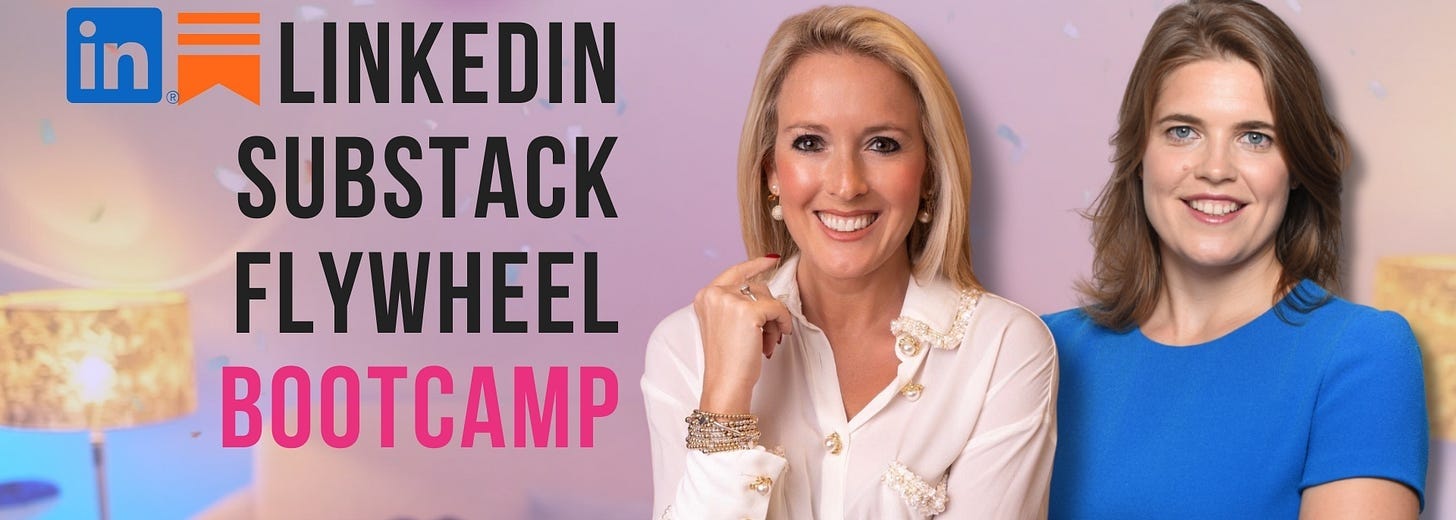
If your scorecard came in under 7, and you want the full system laid out step by step - the profile teardown, the About page rewrite, the four-essay sequence, and the Notes cadence - Kristina God and I are running a three-day bootcamp on 18–20 August that walks you through the whole flywheel.
Next Sunday, I will go into more depth on move one: the LinkedIn profile teardown, with a live before-and-after. If you want that in your inbox, subscribe below.
The wheel does not turn itself, but once you start it, it does not stop (in the best possible way).
From early bird to another early bird . Good timing , feeling a build-up into choices. Once I know the price for the bootcamp, I’ll start making homework. Main issue …can I handle multiple platforms? On a technological space point of view. Meaning building a business while I have a pension as income which means either building a business and postpone pension (which I’m never really in) and also …Business as I like it the most is like …Maverick ‘ book written by Ricardo Semler. It resonates the best with who I am. Your article now pushes me towards myself first. Thanks for awakening that in me.



From early bird to another early bird . Good timing , feeling a build-up into choices. Once I know the price for the bootcamp, I’ll start making homework. Main issue …can I handle multiple platforms? On a technological space point of view. Meaning building a business while I have a pension as income which means either building a business and postpone pension (which I’m never really in) and also …Business as I like it the most is like …Maverick ‘ book written by Ricardo Semler. It resonates the best with who I am. Your article now pushes me towards myself first. Thanks for awakening that in me.
Smart move... Too many people learn the hard way that a platform shift or an algorithm tweak can instantly wipe out years of hard work.